SP Jain Institute of Management & Research Interview
SPJIMR, Bharatiya Vidya Bhavan

SPJIMR is a premier private B-school based in Mumbai, competing with institutes like XLRI and ISB. Traditionally known for specialized MBAs, it launched a more general programme called MBA (Business Management) in recent years.
Two aspects of its admissions stand out:
Profile-based shortlisting: They take your holistic profile very seriously, even releasing a shortlist before CAT results are even out! However, minimum score thresholds still apply. They also release a profile-cum-score based shortlist after the scores are declared. Ultimately, there will be a highly diverse group in this college. But, no score guarantees you an interview call here.
Group Interviews: SPJIMR follows a unique interview process where they have two rounds of group interviews, the first one being an elimination round. The group aspect adds some interesting dynamics for standing out and delivering answers. It is a very loose simulation of how you work in groups.
Interview
Timeline and Location
Profile-based calls were released in the late-December, followed by score-based calls in early-January. Interviews were conducted across major cities with flexible scheduling.
My Interview's Overview
| College Name | University | Date and Time | Interview Location | Number of panellists | Number of rounds | Course |
|---|---|---|---|---|---|---|
| Bharatiya Vidya Bhavan's S.P. Jain Institute of Management and Research | Bharatiya Vidya Bhavan | 2026-02-02 7:45 AM | Institute of Hotel Management, Bengaluru | 2 | 2 | MBA (Business Management), MBA (Information Management and Analytics) Programmes |
Structure
SPJIMR Interviews follow the following process:
- Attendance: Unlike other colleges, there is no document verification at this stage. You can walk in with just a document to prove your identity, and you're good to go.
- Caselet reading activity: A common caselet is provided to every member there. You are free to read it, however you cannot write or jot down anything. This caselet only becomes relevant in G2 (see below), hence it serves as a minor test of memory as well, beyond the expected analytical skill test. Focus on completely understanding the problem statement and in figuring out your analysis over the situation.
- G1: The G1 round focuses on your 'SPJIMR Form A' information, which is mostly about your introduction, work-experience etc. This round if quite generic without many patterns to mention.
- G2: The G2 round starts with the caselet reading activity, moves to scenario question, before questions are asked which are related to 'SPJIMR Form B', which asks more abstract questions to gauge your personality and growth.
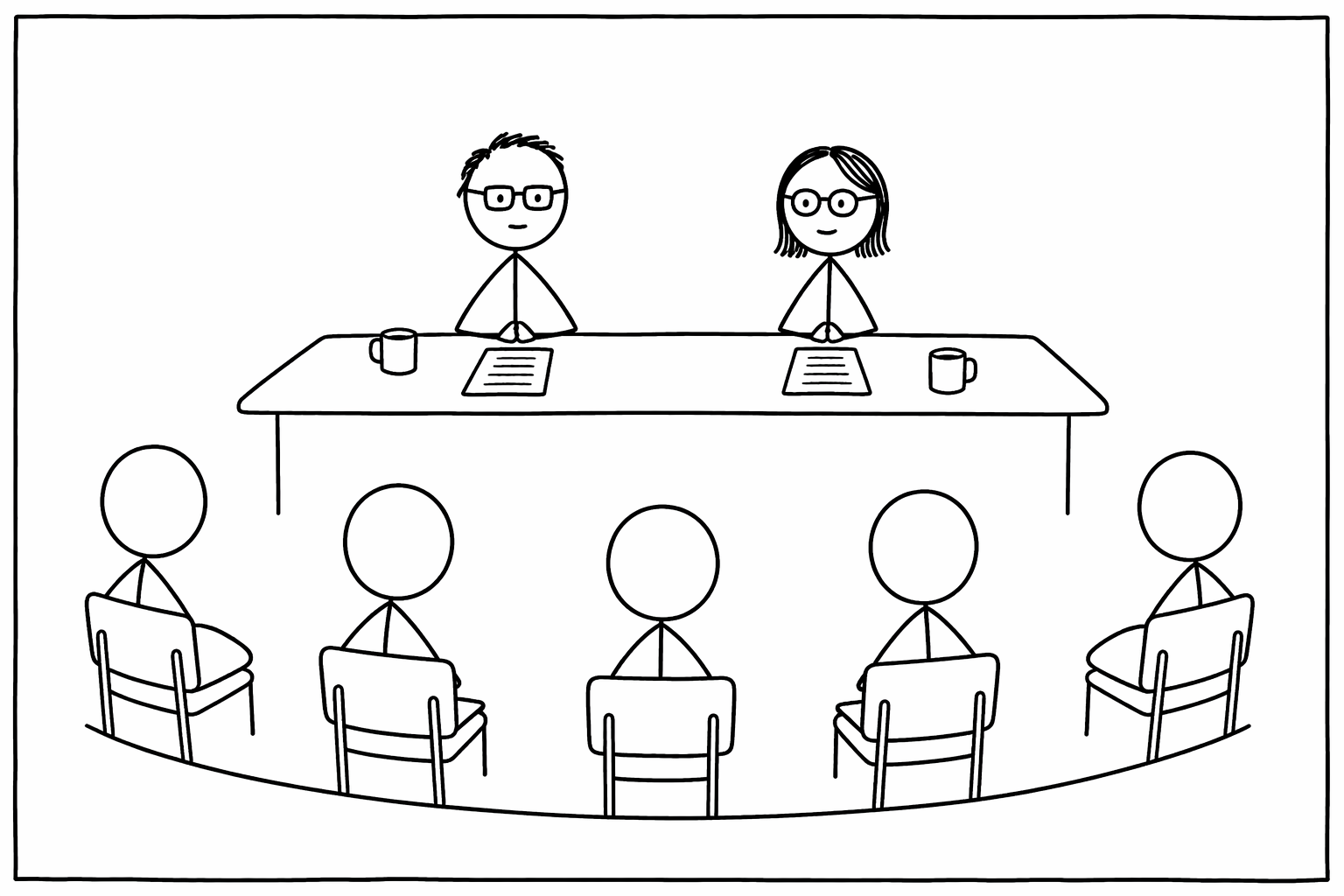
My G1 Panel had 4 people and was interviewed by 2 men. 3 out of 4 members of my group were shortlisted for similar specializations. I was the only person from my group to move to G2, for which new groups were formed. My G2 group had 5 people, with a male and a female interviewer.
Transcript
Panellists closely observe how well you listen and engage with others. Referencing peers' points, maintaining eye contact, and building on ideas are all valued. One of the candidates from my group recalled an experience from a year ago where his fellow group member was asked which undergraduate college someone else was from, and he couldn't answer!
CaseletAn entrepreneur wants to launch an electric cab service after BluSmart's exit. The dilemma:
There were some additional challenges related to EV operations. |
G1The four members of my group walk into the interview room. We are seated in a specific order for the interviewers to easily identify and evaluate us. Interviewer: Introduce yourselves with something interesting and mention your shortlisted course. Every member in the group mentioned music in one way or another. Interviewer: Since everyone here likes music, let me ask about that. Tell me how music can help a leader. Anyone can start. The candidate on the far-left asked for our permission before going first. Me: Music influences mood and is a stress buster. My guitar is what I return to after a long hectic day of work. Working with musicians in a band or choir settings, which can turn quite tense, improve your teamwork and negotiation skills. If we look at examples like the National movement in India, music also possesses a magic that is capable of binding large groups of people together under one spirit. Interviewer: It seems three of you have been shortlisted for the PGP Information Management course. Tell me, what is Information Management. A candidate struggled. Interviewer: What is the difference between data and information? You can start from the left and go to the right. All answered. I was asked a follow-up_ Interviewer: Give me an example of you using information management in your work. Interviewer: What is Agentic AI? My answer missed the mark. Another candidate answered better Interviewer (to marketing candidate): What is Digital Marketing? Give me an example of push and pull marketing. Interviewer: What excites you most in the Union Budget? Anyone can start. Answered sequentially. Thankfully, I was able to add new points despite being the last candidate to speak. Interviewer: AI got a lot of focus in this budget. What are the biggest challenges in implementing AI for farmers? The round started from the left again. I was a little panicked since he phrased it as though there were some 'official challenges' mentioned in the budget, which I had not read/heard about. The other candidates spoke as though they knew of specific challenges. The few points that I had thought up were already touched upon by the other candidates. I decided to take a safer route by being transparent about my ignorance and instead offered my own analysis, qualitatively improving upon points mentioned by my peers. Me: I am not aware if any official challenges were mentioned along with the budget. However, I can provide my own analysis. One challenge is that rural areas have poor internet adoption, making it difficult to spread AI in general. To provide an alternative to this, the government is building centres where AI will be made accessible to farmers, however I think that language would still be a big barrier. Most farmers would not know English, and most LLMs these days are trained on English, making them poorly compatible with Indian languages. We would need LLMs trained on numerous Indian Languages to make the technology truly accessible. |
G1 Result
My group went back to the waiting area and waited for 20-30 minutes before the G1 results came. Each group was called aside and the names of the qualified candidates were announced. Eliminated candidates were free to go home. I was the only one from my group to move to G2.
G2A new group of 5 was formed. Interviewer 1: Welcome everyone. We've already had a look at your forms so why don't you all mention something about yourself that isn't already mentioned in your form. I hadn't mentioned many things about myself, which allowed me to talk a lot here (though it came to bite me back later). Interviewer 2: You mentioned being a musician. Why don't you draw a parallel between being a musician and being a leader? I talked about how leadership is required in a band. A few questions were asked to my peers as well related to their introductions. Interviewer 1: Define the case problem. She pointed at the woman who was seated in the far-right. After her answer, she sequentially asked two more people. Interviewer 2: What should the CEO do? This question was asked to two people, including me. I began answering but was stopped early. Depth was not required. Interviewer 2: Do you think mixed hostels are good or bad? This question was asked towards me. I answered that I thought it was good and explained the benefits of having them. 4 out of 5 members of the group shared my opinion, while one person was against it. It can be noted that SPJIMR does not have mixed hostels. Interviewer 2: Here's a scenario. You are the representative of all students in a prestigious B-School with a long history. How would you convince the administration to implement mixed hostels. I volunteered to go first and provided an answer. I suggested alternating floors of men and women to have a trade-off between mixing and privacy. There was some back and forth as they reiterated the focus of their question. Others gave various answers. One of them mentioned showing a student poll to the faculty. Interviewer 1: Suppose you did a poll and discovered that 70% of your student body does not want mixed hostels, however 90% of the student council wants it. How would you respond to such a scenario? People gave various answers here too. They'd give short comments or follow-ups to make you doubt whatever choice you say. For example, so you'd betray your council, who you regularly work with for daily issues? After this question they decided to ask questions related to what we filled for Form B. Form B had abstract topics like, 10 sentences about myself, one time when I failed etc. Interviewer 1: We use your forms for getting a whole picture of you. You mentioned a lot of hobbies, however you did not mention them in your form. Why is that? I gave some explanations which didn't seem to convincing to panellist. Interviewer 2: I want each one of you to tell me what you were thinking when you filled the form. I used the question to provide an explanation for my previous question. I elicited a laugh from the panellists. |
Impressions
Each round lasted ~30 minutes. The process was quite professional, and it rewarded creativity, clarity, listening skills and the ability to build on others ideas.